Blog / Product
The Unnecessary Divide Between AI and Traditional 3D Modelling
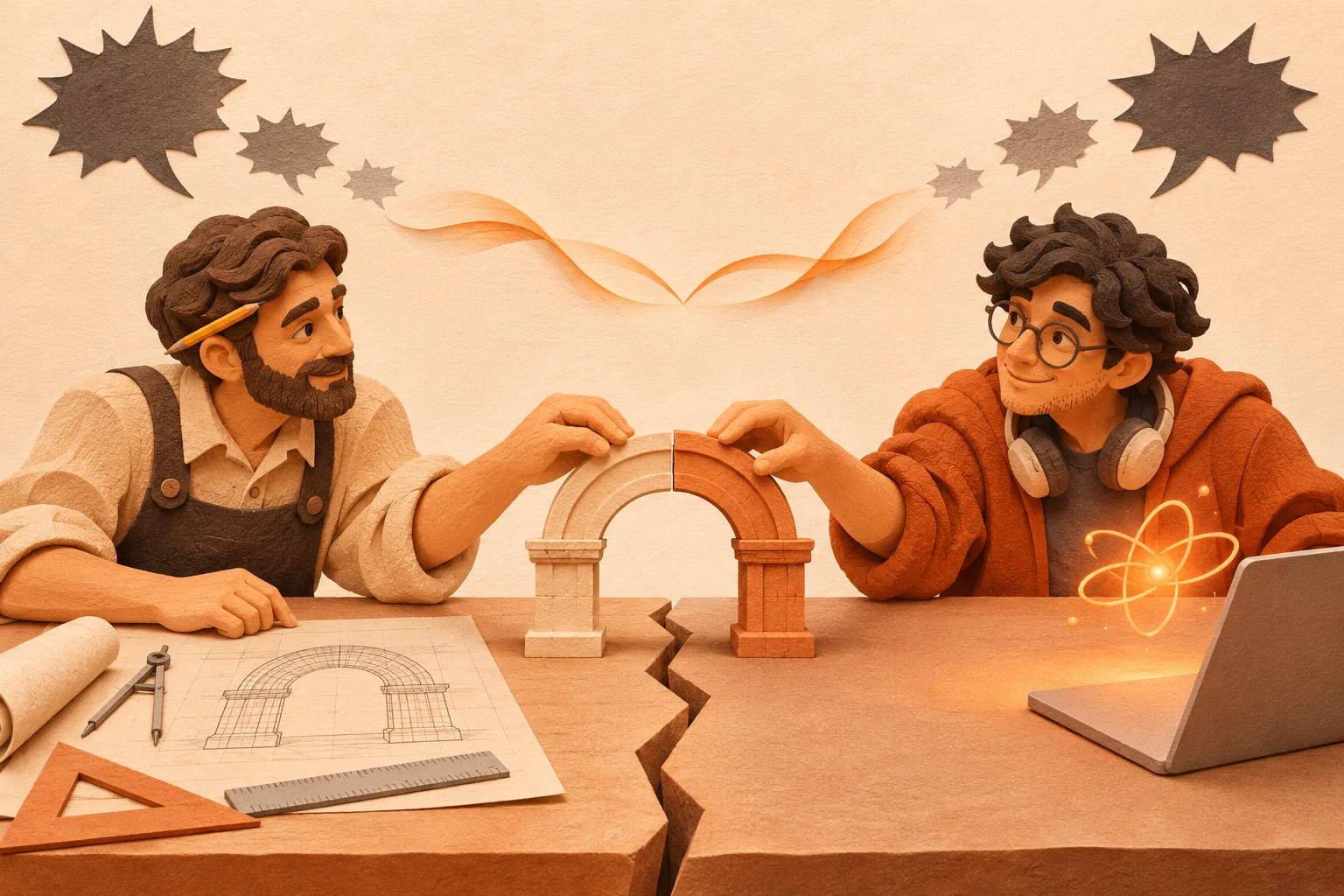
Why have we reached a point where people feel the need to discredit someone else's work simply because they used a different approach?
We've all seen it by now. Someone posts an AI-generated 3D model, and within minutes the comments are filled with remarks like "AI slop", "where's the skill in that?" or "just learn to model properly".
And then there's the other side. Someone shares a traditionally modelled piece of work, and AI enthusiasts rush to explain how they could have generated the exact same thing in ten minutes, how traditional modelling is outdated or how there's simply no reason to spend hours doing something AI can supposedly do for you.
In both cases, the comments can become quite unpleasant.
What's particularly interesting is that both groups are often working towards exactly the same thing: creating something. Yet, for some reason, they've developed an almost instinctive need to undermine each other's work.
But why? Why has something as relatively straightforward as choosing how to create a 3D model turned into such a divisive topic?
How did we get here?
I think part of the problem comes from how quickly AI has entered an industry that has spent decades developing its own tools, techniques and communities.
For someone who has spent years learning Blender, mastering complicated workflows and gradually improving their modelling skills, watching an AI generate something in seconds can feel quite discouraging. There's a lot of time, patience and practice behind traditional 3D modelling, and it's understandable that some people feel that this is being overlooked.
Imagine spending several days creating a detailed model, only to have someone dismiss it because an AI could supposedly produce something similar in a fraction of the time. It doesn't exactly feel great.
There's also a genuine concern about the wider implications of AI. Questions around training data, copyright, originality and the impact on professional artists and designers aren't imaginary problems. They're worth discussing, and dismissing every concern as someone being afraid of new technology doesn't help anyone.
But then there's the other side.
For people who embrace AI, the technology represents something they've wanted for years: the ability to turn an idea into something tangible without having to spend years learning the technical skills required to create it.
Someone might have an incredibly detailed vision for a product, a mechanical component or an architectural concept but simply lack the experience to model it. AI gives that person an opportunity they might never otherwise have had.
And when someone dismisses their work purely because AI was involved, it can feel as though they're being told that their ideas are somehow less valuable because they didn't have the technical ability to execute them manually.
Both frustrations are understandable. Neither justifies the hostility.
The argument about skill is missing something
One of the most common arguments against AI-generated models is that they require less skill. And, in many cases, that's true.
But I think we're confusing two very different things: the skill required to operate a tool and the ability to create something worth making.
A person who has spent ten years learning CAD undoubtedly has technical abilities that someone using text-to-3D generation might not possess. That experience matters, particularly when creating mechanically accurate, functional or production-ready models.
But does that mean someone who uses AI has no creative ability?
I don't think so.
Knowing what you want to create, understanding proportions, making design decisions, refining an idea and recognising when something isn't right are all valuable abilities. AI might handle some of the technical execution, but that doesn't automatically mean the person behind the idea contributed nothing.
Equally, being able to generate a model in seconds doesn't make someone a better modeler than the person who spent three days constructing it manually.
Speed isn't the only measure of quality, and neither is the number of hours spent creating something.
A beautifully constructed traditional model deserves recognition. So does a genuinely impressive AI-assisted creation. They don't have to compete for legitimacy.
And to the AI enthusiasts: traditional modelling isn't obsolete
I think this is something that deserves just as much attention.
There's a tendency among some AI enthusiasts to treat traditional modelling as though it's an outdated way of working. The argument usually goes something like this: why spend hours creating something manually when AI can do it for you?
But this overlooks what actually makes 3D modelling useful.
Generating something that looks convincing is one thing. Creating something with precise dimensions, properly constructed components, editable geometry and predictable behaviour is another.
There are plenty of situations where traditional modelling is still the more appropriate approach. An engineer designing a mechanical component, for example, might need exact tolerances and control over every feature. A text prompt isn't necessarily going to provide that.
And even when AI can produce a suitable starting point, someone with modelling experience may still need to inspect, adjust and refine the result.
AI is an incredibly useful addition to the industry, but pretending it can already replace every aspect of traditional modelling is just as unreasonable as pretending it has no place in the industry at all.
We're all trying to achieve the same thing
This is probably the part I find most frustrating about the divide.
Strip away the arguments, the comments and the constant comparisons, and what are we actually left with?
People who enjoy creating 3D models.
Some prefer spending hours constructing every detail themselves. Others prefer describing an idea and letting AI handle much of the technical work. Some want a combination of both.
Why should these approaches be mutually exclusive?
I don't see why someone who enjoys traditional modelling should feel threatened by someone using AI, or why someone who embraces AI should feel the need to dismiss the skills developed by traditional modelers.
You can appreciate a beautifully constructed model without needing to know how it was made. You can also appreciate an impressive AI-generated creation without pretending that the technology has solved every problem in 3D modelling.
There's room for both.
And perhaps the more interesting question isn't which approach is better, but how much more we could achieve if the two were allowed to work together.
A little about what we're building at Objify
This is actually one of the reasons behind our thinking at Objify.
We don't believe that AI should replace conventional CAD tools, nor do we believe that everyone should have to rely entirely on AI to create something.
We want to bring the two together, allowing people to generate models through AI while retaining the ability to work on them manually, make adjustments and have control over the final result.
We think the future of 3D modelling should give people more options, not force them into one particular way of working.
Perhaps we should stop making it a competition
I'm not suggesting that everyone has to like AI, use AI or agree with everything happening in the industry. There are perfectly reasonable criticisms to make, and there will always be differences in opinion.
But there's a difference between criticizing a technology and deliberately belittling someone for using it.
The same applies in reverse. Embracing AI doesn't require you to dismiss traditional skills or undermine people who prefer to do things themselves.
We spend so much time arguing about whether something was made by AI or by hand that we sometimes forget to actually look at what was created.
Perhaps it's time we gave a little more attention to the work itself, rather than immediately searching for a reason to discredit the person behind it.
After all, we're all here because we enjoy making things. It seems rather unfortunate that we've managed to turn that into something to argue about.